As orders increase, managing raw meat, breakdown yields, recipes, variable weights, production and traceability becomes harder to coordinate. Supply’d connects each step so your team can plan confidently, maintain control and keep products moving without relying on disconnected systems or manual records.

Most butcher software manages only one part of the operation. Supply’d connects customer demand, purchasing, raw materials, breakdown, production, picking and delivery in one platform. From the moment an order is received, every team can see what needs to happen next.


Supply’d gives butcheries one system to manage the movement of meat from supplier receipt through breakdown, production, packing, sale and delivery. Stock, weights, yields, batches and customer orders remain connected throughout the process, giving every team clearer information and stronger control.


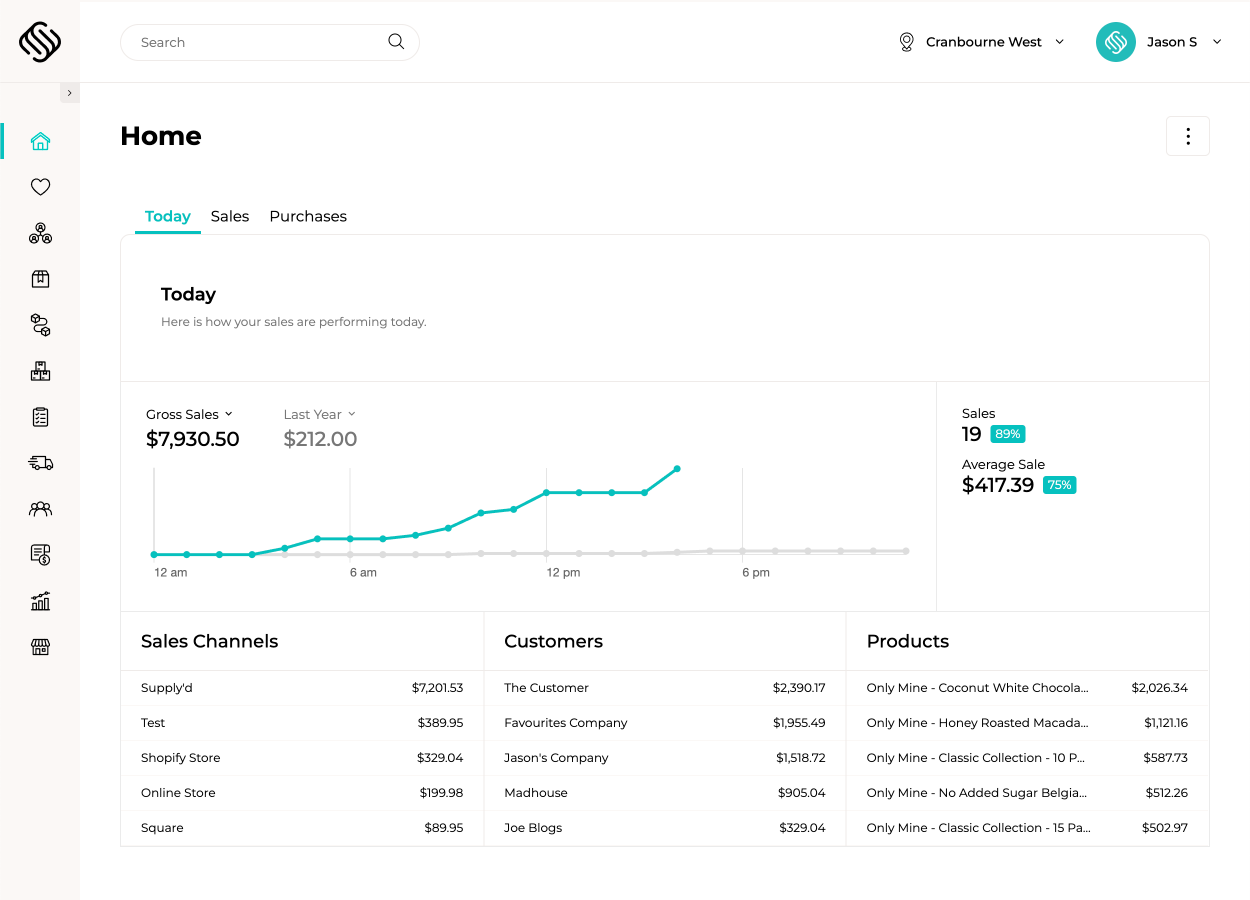
Give every team one connected way to manage demand, raw materials, production, fulfilment and traceability across the entire operation.
Record raw input weight, guide breakdowns and capture the actual quantity produced across cuts, trim, mince, waste and by-products. Supply’d compares expected and actual yield so you can understand where value is being gained or lost.
Explore Production Management| NUTRITIONAL INFORMATION | ||
Create and manage raw cuts, portioned products, recipes and value-added lines from one product record. Define ingredients, allergens, pack sizes, target weights, costs, labels and barcodes so accurate product information flows through purchasing, production, sales and fulfilment.
Explore Product ManagementPlan purchases around customer demand, production requirements and the stock already available across each batch. Supply’d helps your team identify what needs to be ordered, account for supplier pack sizes and lead times, and avoid buying too much or discovering shortages after production has started.
Explore Purchase ManagementBring wholesale orders, retail sales and connected sales channels into one place. Customer pricing, standing orders, delivery requirements and product-specific details flow into planning and fulfilment without separate spreadsheets or repeated data entry.
Explore Sales Order ManagementTrack meat by product, batch, expiry, weight and storage location from receiving through to dispatch. Use supported scanners to move stock, complete stocktakes and guide picking while maintaining full traceability across chillers, freezers, production areas and finished-goods storage.
Explore Warehouse Management

Plan efficient delivery routes with Supply’d Intelligence based on orders, vehicles and customer requirements. Drivers can complete runs on a Supply’d PDA scanner, view delivery instructions and capture digital proof of delivery at each stop.
Explore Delivery Management
Report on sales, margins, purchasing, inventory, production, waste and product performance across the business. Because Supply’d also connects supplier batches, expiry dates, breakdowns, finished goods and customer deliveries, your team can investigate issues quickly and complete targeted recalls with confidence.
Explore Business Intelligence
Complete food-safety and quality checks at receiving, during breakdown and production, and before finished products are released. Record temperatures, condition, weights, corrective actions and other required checks against the relevant supplier batch or production run.
Explore Quality Management

Supply’d Intelligence turns operational data into action. It helps forecast demand, recommend purchasing, plan production, read incoming orders and invoices, and optimise delivery, all within the workflows your team already uses.
Explore Supply'd Intelligence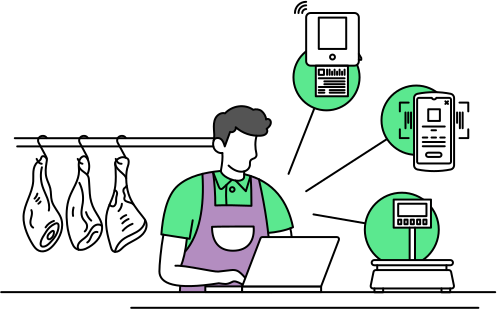
Connect the devices your team uses across receiving, breakdown, production, packing and dispatch. Supply’d works with supported scales, scanners, printers, tablets and mobile devices so weights, batches and completed work can be recorded where the work actually happens.

Implementation is tailored to the size and complexity of your operation. Choose structured remote onboarding or deeper planning, data support, onsite training and go-live assistance through our Discovery & Implementation Program.
Explore ImplementationSupply’d ERP runs the operational side of your business, including purchasing, breakdowns, production, inventory, orders, fulfilment and delivery. Financial information can then flow into supported accounting platforms such as Xero and MYOB, allowing your finance team to retain its existing accounting workflow.










Supply’d combines meat-processing workflows with purchasing, inventory, wholesale ordering, warehouse, delivery and reporting in one connected system, helping growing butchers replace paper, spreadsheets and disconnected tools with clearer, repeatable processes.

Explore how Supply’d could connect purchasing, breakdowns, production, inventory, wholesale orders, warehouse, delivery and reporting across your business.
Book a demoYes. Supply'd can guide staff through breakdown workflows, starting with the raw input weight and recording the actual quantities produced across cuts, trim, mince, waste and by-products. This gives your team a clear view of what was produced and how each breakdown performed.
Yes. Supply'd compares expected yield with the actual quantity produced during a breakdown. This helps identify variation across carcasses, suppliers, products and staff, while showing where yield loss is affecting cost and margin.
Yes. Supply'd can manage products that are bought, stocked, produced and sold by weight. Actual weights can be captured during receiving, production, picking and packing so inventory, pricing and order quantities reflect what physically moved through the operation.
Yes. Supply'd supports connected scale workflows through compatible Wedderburn equipment. Scales can be used during guided weigh-up, breakdowns and other weight-based workflows to help reduce manual entry and improve the accuracy of recorded weights.
Yes. Supply'd supports recipes, sub-recipes and multi-stage production for products such as sausages, marinades, ready meals, burger patties and smallgoods. Ingredients, labour, batches, allergens and finished-product costs remain connected throughout production.
Yes. Supply'd combines customer orders, standing orders, forecasts, inventory and production requirements to recommend what needs to be broken down or produced. This gives your team a clearer production plan without manually rebuilding requirements in spreadsheets.
Yes. Smart Purchasing considers production requirements, sales demand, current stock, supplier lead times, minimum stock levels and purchasing rules to recommend what should be ordered. Your team can review and approve purchase orders before they are sent.
Supply'd records supplier batches and expiry dates during receiving, tracks which batches are consumed during breakdowns and production, and connects finished-product batches to the customers who received them. This provides traceability from supplier through processing and fulfilment.
Yes. Enter an ingredient, raw-material or finished-product batch number to see where it came from, where it was used and which customers received affected products. Recall information can then be produced for internal reviews, customer enquiries and audit preparation.
Yes. Supply'd tracks batch and expiry information and can guide teams to use stock according to first-expired, first-out rules. This improves stock rotation, helps reduce avoidable waste and strengthens control across receiving, production and fulfilment.
Yes. Digital checks and recurring tasks can be built into production and operational workflows. Staff can record temperatures, cleaning checks, corrective actions, metal detection results and other required information, creating a permanent time-stamped record for your food-safety program.
Yes. Supply'd can generate configurable product, batch, carton and pallet labels using information already held in the system. Labels can include product details, barcodes, batch numbers, expiry dates, ingredients and allergens where required.
Yes. Supply'd can separately track material, labour and overhead costs and apply them to breakdowns and production. Combined with actual weights and yield, this gives your team a clearer view of product cost, margin and where value is being lost.
Yes. Supply'd supports customer groups, pricing tiers, customer-specific pricing and controlled product ranges. The correct prices and products are applied when customers order through Supply'd Lite or when your team enters an order for them.
Yes. Customers can use Supply'd Lite to place orders using their own product range, pricing and ordering rules. Orders flow directly into Supply'd ERP, reducing email, phone orders and manual entry.
Yes. Supply'd supports scanner-based receiving, stocktakes, guided picking, wave picking, packing and batch selection. Warehouse teams can work from live instructions while inventory and order quantities update as work is completed.
Yes. Supply'd can plan delivery routes, assign vehicles and drivers, manage delivery instructions and capture proof of delivery. Delivery workflows can also include signatures, photos, temperatures and other required fields.
Yes. Supply'd supports multiple locations, departments, warehouses, production areas and user permissions within one connected platform. This gives head office central visibility while allowing each site or team to manage the work relevant to them.
Supply'd is designed to run the operational side of the business, including purchasing, breakdowns, production, inventory, orders, fulfilment and delivery. Financial information can then be sent to supported accounting platforms such as Xero and MYOB, allowing your finance team to retain its existing accounting workflow.
Supply'd is cloud-based and can be used across computers, tablets and supported mobile devices. Butcher teams may also use connected scales, PDA scanners, tablet scanners, barcode and label printers, and production tablets for receiving, breakdowns, production, picking, packing and stock control.
Implementation can include operational discovery, data migration, product and process setup, breakdown configuration, integrations, hardware setup and staff training. The process is tailored to the complexity of your operation rather than assuming every butcher cuts, weighs and fulfils orders in exactly the same way.